AI Adoption & Strategy
How to Build the Business Case for AI in Your Team
You believe AI can help your team. The person who signs off wants to know what it's worth. Here is how to answer with your own numbers, in a way a careful finance lead will trust.
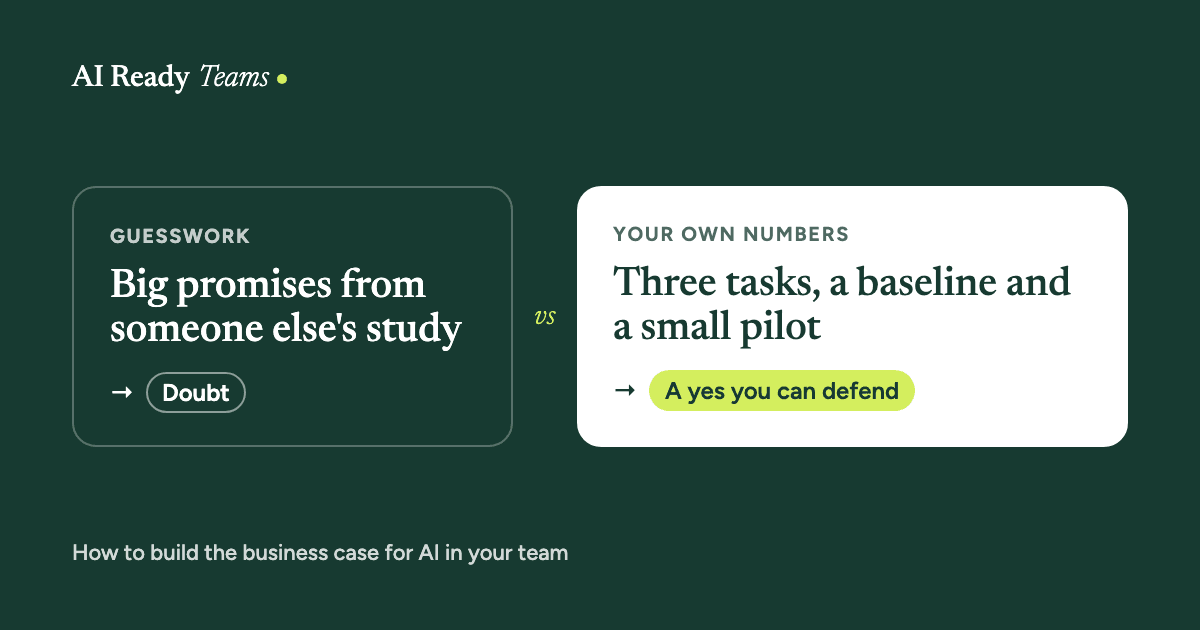
Most AI business cases fail for the same reasons. They borrow a big percentage from someone else's study. They count licences instead of use. They have no baseline, so nobody can tell later whether anything changed. And nobody owns the result.
A good business case is smaller and more honest than that. It picks a few real tasks, measures them, estimates a cautious saving, counts every cost, and asks for a short pilot instead of a big promise.
Step 1: Pick three recurring tasks
Don't start with "AI strategy". Start with work that happens every week and that everyone recognises. Good candidates:
- Writing follow-up emails after meetings or calls.
- Preparing a regular report or update.
- Answering the same internal questions again and again.
- Summarising long documents before a decision.
- Turning rough notes into a plan, a proposal or a brief.
Avoid your most sensitive process as a first example. Pick tasks where a mistake is easy to catch and cheap to fix.
Step 2: Measure the baseline
For each task, write down who does it, how often, and how long it takes each time. Ask the people who do the work, not their managers. If you can, time it for one normal week. This number is the most important one in your case, because it's the one you'll compare against later.
| Task | Who does it | How often | Time each | Hours a month |
|---|---|---|---|---|
| [Task 1] | [Role or name] | [per week] | [minutes] | [total] |
| [Task 2] | [Role or name] | [per week] | [minutes] | [total] |
| [Task 3] | [Role or name] | [per week] | [minutes] | [total] |
Step 3: Estimate a cautious saving
Don't use a percentage from a vendor, a study or a headline. Their teams, tasks and tools aren't yours. Instead, let two or three people try AI on each task for a week or two, including the time it takes to check the output. Then write down two numbers:
- Cautious: the saving you'd still defend if things go slower than hoped.
- Likely: what you actually saw in the trial.
Presenting both shows you're not overselling. That alone makes your case more believable.
Step 4: Put a value on the time
Multiply the hours saved by your team's average hourly cost, including benefits. Your finance team can give you that figure.
Be honest about one thing: saved time is only worth money if it goes somewhere useful. Say what the team will do with it, for example faster replies to clients, fewer late reports, or time for work that keeps getting pushed back.
Step 5: Count every cost
- Licences, if you don't already pay for them.
- Training, and the team's time away from work to attend it.
- Setup time: accounts, settings and rules for what goes into AI tools.
- Checking time: people reviewing AI output before it's used.
- Someone's time to own the pilot and report back.
Leaving costs out is the fastest way to lose a finance lead's trust.
A worked example
These numbers are made up to show the maths. They are not a benchmark or a promise. Replace every one with your own.
A team of 8 has three recurring tasks. A month is counted as 4 weeks, and the average hourly cost is $50.
| Task | How it adds up | Hours a month |
|---|---|---|
| Meeting follow-ups | 8 people, 3 a week each, 20 minutes each | 32 |
| Monthly report | 1 person, once a month, 6 hours | 6 |
| Repeat questions | 8 people, 1.5 hours a week each | 48 |
| Total | 86 | |
The trial suggests a cautious saving of 20% and a likely saving of 35%.
| Cautious (20%) | Likely (35%) | |
|---|---|---|
| Hours saved a month | 17.2 | 30.1 |
| Value a month, at $50 an hour | $860 | $1,505 |
| One-off cost: training day for up to 10 people | $10,000 | $10,000 |
| One-off cost: 8 people away for a 7-hour day | $2,800 | $2,800 |
| Months to pay back $12,800 | About 15 | About 9 |
| After 12 months | $2,480 still to recover | $5,260 ahead |
Example only. This team already pays for its AI licences, so they aren't counted.
Notice that the cautious case doesn't pay back within a year. That's fine to show. It tells the decision-maker you're being straight with them, and it makes the pilot in Step 7 the obvious next move.
Step 6: Name the risks, and how you'll manage them
- Data: people paste things they shouldn't. Agree simple rules first. Our data-safety guide is a good starting point.
- Quality: AI can be confidently wrong. Build a human check into every workflow.
- Use: a few people use it, most don't. Train on real tasks, and name someone to own each workflow.
- Time: the pilot takes effort before it saves any. Protect a little time for it.
Step 7: Ask for a 30-day pilot, not a big bet
A small pilot is much easier to approve than a company-wide rollout. Make it concrete: one team, the three tasks, one owner, a start date and a check date. At the check date, measure the same tasks the same way as your baseline, and decide together whether to stop, adjust or expand.
What to measure after the pilot
- Time: hours on the three tasks, measured the same way as the baseline.
- Quality: errors caught, rework and complaints.
- Use: how many people used AI on these tasks each week.
- Confidence: the same readiness scorecard, before and after.
Your one-page business case
Keep it to one page, with these headings:
- The problem, in one or two sentences.
- The three tasks and today's baseline.
- The pilot: team, owner, start date and check date.
- All costs.
- Cautious and likely benefit, with the maths shown.
- Risks, and the rules you'll follow.
- What you'll measure, and when you'll decide.
Let Claude do the maths with you
Paste this into Claude, fill in the brackets with your own numbers, and check every figure it gives you.
Build my AI business case
Help me build a short, honest business case for using AI in my team. I need to convince [who decides, for example our CEO or finance lead].

My team: [number] people who [what the team does].
The 3 recurring tasks I think AI could help with:
1. [task], done by [who], [how often], about [time] each time
2. [task], done by [who], [how often], about [time] each time
3. [task], done by [who], [how often], about [time] each time

Costs I know about: [licences, training, setup time]
Average hourly cost for my team, including benefits: [amount]

Please:
1. Work out the hours each task takes per month, and show your maths.
2. Show a cautious case and a likely case for time saved, using these percentages: cautious [20]%, likely [35]%. Don't invent your own.
3. Turn the saved hours into dollars, and work out the payback period for each case.
4. List the risks and how to manage each one.
5. Draft a one-page summary with a 30-day pilot and a clear check date.

Use only my numbers. If something important is missing, ask me before you start.
Want to go further? Connect Google Drive, OneDrive or SharePoint so Claude can read your real numbers, and ask for the final version as a Word document or slides. Our connectors and skills explainer shows how.
Build a team that is ready.
Your team already has access to AI. The next step is helping them use it well.
Start with one team, one workflow and one measurable improvement.